From Data to Action: TRUST Project Brings Stakeholders Together to Advance Data-Driven Road Safety Solutions in Bangkok
BANGKOK, THAILAND

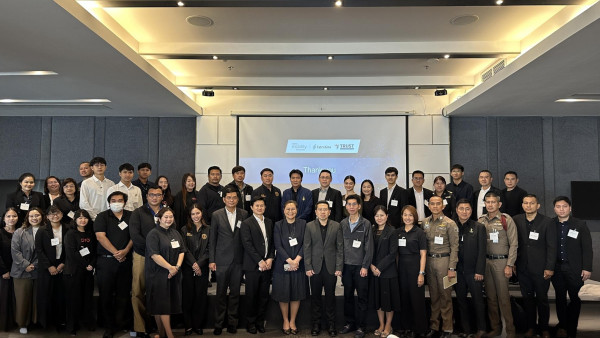
BANGKOK—The TRUST (Thailand Road Users Safety through Technology) Project convened a multi-agency validation workshop in Bangkok, bringing together key stakeholders to translate data-driven road safety analysis into a practical, coordinated action plan for high safety risk locations in the Chatuchak district.
Launched in April 2025, the TRUST Project is a collaborative initiative involving the Toyota Mobility Foundation (TMF), Bangkok Metropolitan Administration (BMA), UN-Habitat, Asian Institute of Technology (AIT), Toyota Motor Thailand Co., Ltd. (TMT), and Road Accident Victims Protection Co., Ltd. (RVP). The project applies AI-based analytics, systematic data collection, and spatial analysis to proactively identify accident risks and unsafe road user behavior before they result in serious crashes.
The workshop convened representatives from key public and private sector organizations, including the Bangkok Metropolitan Administration (BMA), the Department of Disaster Prevention and Mitigation (DDPM), the Office of Transport and Traffic Policy and Planning (OTP), the Department of Land Transport (DLT), the Metropolitan Police Bureau, the Chatuchak District Office, the Honda Thailand Foundation and Toyota Motor Thailand Co., Ltd., Participants worked together to validate findings, align priorities, and identify practical countermeasures to improve road safety
Bangkok continues to face persistent road safety challenges, particularly in high-traffic corridors where vulnerable road users — including motorcyclists and pedestrians—are disproportionately affected. Addressing these issues requires not only robust data analysis, but also the ability of responsible agencies to align together on priorities and move toward implementable solutions.
Targeted Analysis of High-Risk Locations
Under the TRUST Project, road safety assessments identified key blackspots in Chatuchak based on accident frequency and road characteristics. Three priority locations were selected for in-depth study:
- G2: Wat Samien Naree School (Primary school front)
- G4: Ratchada–Ladprao Intersection (Major intersection)
- G5: Ratchada Soi 32 (Major road merge point)
To improve the accuracy of diagnosis, the project combined CCTV footage, drone footage, and AI-supported analytical tools, including the DataFromSky (DFS) and Transoft Solutions software, selected according to site conditions. These technologies supported the analysis of traffic movements, conflict patterns, and high-risk road conditions, enabling the development of targeted road safety countermeasures.
In addition to accident records, the analysis incorporated near-miss detection using the Time-to-Collision (TTC) index, enabling the project to identify risky interactions that may not be captured through conventional observation or historical crash data alone. This approach allowed risks to be prioritized based on frequency, timing, and behavioral patterns
Key Findings: Behavioral Risks Driving Collisions
The project found that different Blackspots were associated with distinct conflict patterns and contributing factors. At the blackspot termed ‘G5’ (located in Ratchada Soi 32), for example, both analysis and site observations consistently identified merging and diverging conflicts as the dominant risk pattern. A key contributing factor was improper lane-changing behavior, especially where vehicles cut across lanes to avoid queues at the entrance and exit of the Soi, creating significant conflict between through-traffic and turning movements. More broadly, the project showed that combining AI-based analytics with field observation, improves the ability to connect behavioral risks with infrastructure conditions.
From Insight to Action
The workshop provided a platform for stakeholders to jointly review findings and discuss potential countermeasures across three key dimensions:
- Road and Infrastructure improvements (e.g., lane markings, improve visibility of road users, traffic flow re-design, speed breakers)
- People - Behavioral interventions (e.g., awareness campaigns and driver education) and enforcement measures (e.g. traffic monitoring and compliance enforcement)
- Vehicle (e.g., Vehicle servicing, etc.)
Participants explored short, medium, and long-term solutions, emphasizing the importance of combining these approaches to achieve sustainable safety improvements
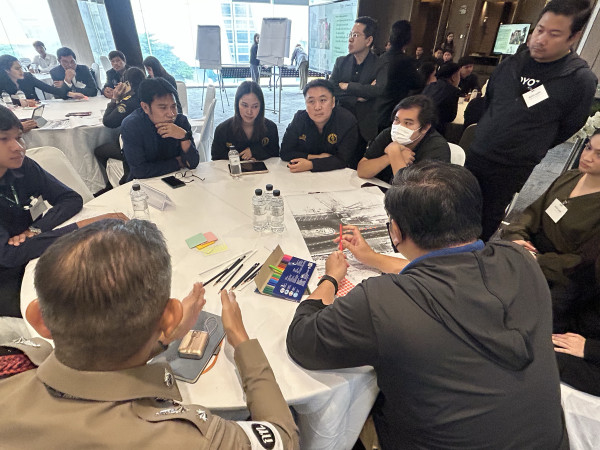
The workshop methodology emphasized practical dialogue focused on solutions. Participants reviewed large-format site maps, identified missing risks and local context, discussed planned initiatives, proposed additional countermeasures, and used prioritization methods such as sticker voting, to identify the most critical and feasible solutions.
Strengthening Collaboration for Safer Streets
This workshop served as an important opportunity to strengthen coordination among relevant organizations, align thinking and accelerate the implementation of road safety measures in Bangkok.
Based on the analytical findings, participants discussed priority countermeasures tailored to local conditions, while aligning organizational roles and identifying pathways for implementation. The workshop also promoted knowledge-sharing across related initiatives, including observer participation from the KUB-DEE-DAI-DEE (KDDD) Project, helping foster stronger collaboration across road safety and sustainable mobility initiatives in Bangkok.
By bringing together diverse stakeholders around a shared evidence base, the TRUST Project aims to translate data-driven insights into practical actions and accelerate the implementation of effective road safety solutions. Going forward, the project will continue to support Bangkok in advancing safer, more inclusive, and more sustainable urban mobility through data-driven planning, technical collaboration, and multi-stakeholder coordination.
About the TRUST Project
Evolving from the insightful discussions of mobility companies and organizations at the Tateshina Meeting in Japan, strategizing on road safety issues, the TRUST Project in Bangkok uses data-driven analytics and technology to identify high-risk accident zones and unsafe driving behaviors with focus on the prioritized focus areas of human behavior, infrastructure and vehicle. The project is a joint initiative of TMF, BMA, TMT, UN-Habitat, AIT, and Thai RVP. Through this initiative, TMF, BMA and its partners aim to create a scalable model for road safety that can be piloted in Bangkok and replicated across Thailand to be shared globally.
About Toyota Mobility Foundation
Toyota Mobility Foundation (Chair Akio Toyoda) was established in August 2014 by Toyota Motor Corporation (Toyota) to support the development of a more mobile society in which everyone can move freely. The Foundation underscores Toyota’s ongoing commitment to continuous improvement and respect for people. It utilizes Toyota’s expertise and technologies to support strong mobility systems while eliminating disparities in mobility. TMF works in partnership with universities, governments, non-profits, research institutions and other organizations, creating programs that are aligned with the UN Sustainable Development Goals (SDGs) to address mobility issues around the world.
“TMF aims to create a truly mobile society that will help people live better lives no matter where they are,” said Chair Akio Toyoda.